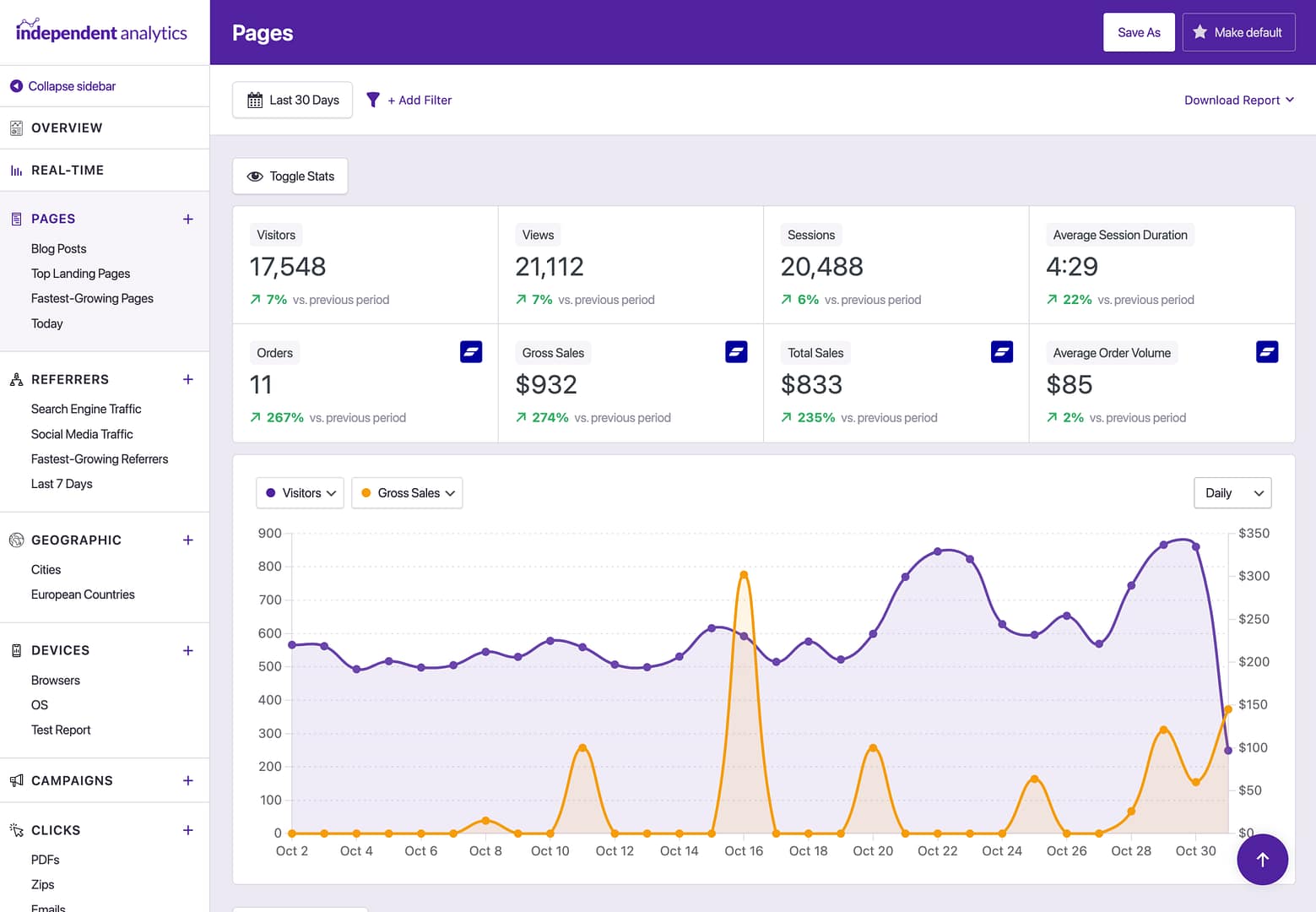
Resolved an error that prevented Solo Reports from loading in the Pages report.
Resolved a PHP error that could occur when loading a report for a user with stats limited to their own content.
Resolved an error that prevented Solo Reports from loading in the Pages report.
Resolved a PHP error that could occur when loading a report for a user with stats limited to their own content.
Visiting the Clicks report with any date range that contained zero clicks caused a fatal PHP error.
Translations were automatically updated for eight different languages in the free plugin via translate.wordpress.org. This update includes those same translations for Pro users.
Certain security features could prevent the asynchronous background task from loading the modules. The Overview now loads by triggering its cron event when viewed.
The vast majority of servers use UTC+0, but for those that don’t, the click tracking feature wasn’t recording clicks.
If a form’s submission button was being tracked with a link pattern, the total number of form submissions could get overcounted to include the click event.
If you have automatic data pruning turned on, the message text could break when email report delivery is paused.
For example, if your site is using Independent Analytics Pro and WooCommerce is installed, and your store has zero recorded sales, the eCommerce metrics in the Quick Stats would show “0” when filtered instead of “0/0” indicating a filter has been applied.
Selecting a User Journeys report for a module would cause a fatal error. Allowing them to be selected was an oversight, and that has now been removed as an option.
For sites without the Imagick PHP extension, favicons would not get generated for the Referrers and User Journey reports. Only the default top 100 sites would get favicons since those are packaged with the plugin.
v2.14.0 added a new daily cron job that gets current values for the site’s average views per session and session duration, which is used for the color gradients in the User Journeys report. This cron job was triggering a PHP error due to an “out of scope” function.
It was not clear that the Landing Page filter was for the title, and not the URL of the page. It is now called the Landing Page Title filter. Likewise, the Page filter was renamed to Page Title.
In Solo Reports, the values for the Visitors Growth and Views Growth columns were not calculated based on the single item being viewed.
Solo Reports were loading much more slowly in Firefox than in other browsers.
v2.14.0 added new favicons to the Referrers report and User Journeys report. The option in the Settings menu to delete all plugin data wasn’t removing the favicon images added to /wp-content/uploads/.
With the new User Journeys feature, you can explore every session recorded on your site. Each one includes a full timeline, letting you see exactly where each visitor came from, which pages they looked at, and any conversions they completed (clicks, form submissions, and eCommerce orders).
Form tracking has been added for Mailchimp for WordPress, Newsletter, Kadence Blocks, and Everest Forms.
When viewing a WooCommerce order, the Customer Journey box now includes a link to all their sessions in the User Journeys report.
Sites using WooCommerce and the YayCurrency plugin will see the eCommerce metrics in IA automatically adjusted to use the store’s base currency.
Line charts in the Overview were hard to read without hovering over the lines to see the legend. Now, the labels are visible by default, so you can easily distinguish between each line.
Before, you had to hover over a pie chart to see the percentage. This is now plainly displayed next to the labels, and the segments are sorted from largest to smallest, making it easier to read.
If you are sending the email report to a group of coworkers, you may want to pause the delivery over the holidays or at other times. You can now do this in one click.
Updated the translations in the Pro version to catch up with the free version.
The salt token can now be refreshed daily, weekly, or monthly.
The data table in the Referrers report now shows the favicon for each site. For some sites, a backup icon will be displayed instead, using a random color and the first letter of the site’s domain.
This should lead to a modest improvement in accuracy when deriving visitor geolocations from their IP addresses.
This allows Independent Analytics to recognize a larger number of device types, including some bots that can be blocked from tracking.
Users with either one of these plugins installed will be notified if an option that disables the REST API or impacts tracking has been enabled, so they can disable it.
Phone numbers in the Target column could display ugly encoding characters if they included a space. Those have been removed so that spaces display normally.
Applying certain filters could cause the number of form submissions to be overcounted in the Quick Stats and chart.
If a form had a title that was more than 64 characters long, the tracking would silently fail. This affected all form integrations. Longer form titles are now trimmed to 64 characters.
Independent Analytics Pro now integrates with FluentCart, so you can find out where your customers are coming from. Connect your sales to their referrers, landing pages, campaigns, and more. Visit our eCommerce Analytics page to learn more.
If multiple links shared the same Target value, the Solo Report would always show data for the first link in the table with a matching Target value.
When the sidebar was collapsed, the labels for the Real-time analytics and Overview report were not displayed properly.
When a Divi form was submitted, IA Pro was tracking the submission even if there was an error and the submission didn’t go through.
Due to a cron scheduling issue, it’s possible that a site could stop tracking geographic traffic if the iawp-geo-db.mmdb file was removed from the wp-contents/uploads folder.
The data migration could fail due to older tables having a different collation. The collation from older tables is always used now, and existing errors are resolved with the migration auto-fixer.
The migration could fail due to a long index. That index is no longer included, and existing errors are resolved with the migration auto-fixer.
The Campaigns report has always shown every unique campaign, but this can make it hard to see how much traffic you get from a campaign when it has lots of different Term and Content fields.
Now, you can group the table by Landing Page, Source, Medium, or Campaign instead. This collapses the table rows so you can easily see data like the total visitors from a specific source, or the number of conversions from a campaign, regardless of the source or medium.
You can now group your referrers by Referrer Type. This will simplify the table so that it only shows rows for Search, Social, AI, Direct, etc. This makes it easy to compare your marketing channels, so you can find what’s working best for your site.
Up until now, the filtering system has required that all of the conditions be met. This is good the majority of the time, but sometimes, you want to match multiple conditions, such as a page that matches one of a few different URLs. You can now tell the filter to match ANY of the conditions instead of requiring a match for ALL of them.
The Order Referrer box has been renamed to “Customer Journey,” and now includes the customer’s time of arrival, time of purchase, landing page, number of pages viewed, device data, and geolocation.
All of the date ranges available in the normal date picker are now available for the Overview modules.
IA Pro now reports sales figures correctly for stores using the Curcy, YITH Multi Currency, and WooPayments plugins. You can find a full list of supported multi-currency plugins here.
Sites like chatgpt.com are now categorized in the new AI referrer type, making it easier for you to see how traffic to your site from AI sites has changed over time.
The world map was previously built using a library from Google. It now uses a library called svgMap, which is bundled in the Independent Analytics plugin.
If you want to create your own widget to show a list of top posts, you can do so with the `iawp_top_posts()` function. In this update, we added the option to choose a specific category to get the posts from. You can learn how to use this function here.
A layer of spam detection was added to keep ugly bot clicks out of the Clicks report.
There are some options that were being auto-loaded for the Overview report, despite only being used on that one page. We’ve disabled auto-loading for these options to gain a minor reduction in performance overhead.
If either of these modules were given a two-column width, they would appear broken when viewed on a mobile device.
Some environments triggered a fatal error when attempting to send the email report due to the line length being too long.
In some environments, the Visitor ID could be returned as a string instead of an integer, triggering an error.
In some environments, the file validation process used for the geolocation database runs extremely slowly. To avoid performance issues, we’ve limited this validation to run once per day at most.
“This tool is great. The free version is enough for 90% of my client sites, more user-friendly than GA and no problems with GDPR.”