
 Ben Sibley
This is a guest post by Felix from Vanfittery. We’d like to welcome him to our blog to share his story about how Independent Analytics Pro helped Vanfittery optimize its marketing and expand its business.
Hi everyone, this is Felix from Vanfittery!
We design and manufacture modular camping solutions that turn everyday vans into campervans within minutes. We are currently in the middle of a major expansion phase, extending our reach from Germany to the wider EU market. Our shop is now live in 9 languages, and we are adding more regions step by step.
While expanding is exciting, it brings a massive challenge: Data blindness.
When you run a local shop, you often have a “gut feeling” about what works. But once you scale to multiple countries and start working with various influencers, “gut feeling” isn’t enough. You need hard data.
This case study explores how replacing our complex analytics stack with Independent Analytics (PRO) helped us track marketing ROI and understand our new international customers without violating strict GDPR privacy laws.
The Challenge: GDPR-friendly data tracking
Before using Independent Analytics, we faced a common dilemma for European shop owners: We needed detailed data to optimize our marketing, but tools like Google Analytics 4 were becoming increasingly complex to set up legally (due to GDPR) and difficult to read.
We often found ourselves asking simple questions that took hours to answer:
- “Did that expensive YouTube collaboration actually sell any products, or did it just bring traffic?”
- “Are our new French visitors actually understanding the checkout, or are they dropping off?”
We needed a solution that was integrated directly into WordPress, privacy-friendly by design, and offered real-time insights without a degree in data science.
Independent Analytics was a perfect solution for us.
In Germany and across Europe, strict GDPR laws require a cookie banner. With traditional tools like GA4, if a user clicks “Decline,” they simply vanish from your statistics. For most shops, this means flying blind on 40% to 60% of their actual traffic. Since Independent Analytics is privacy-friendly by design and doesn’t use tracking cookies, we can legally track all visits without needing a “Yes” from the cookie banner.
For the first time, our dashboard actually matches our reality. We are no longer guessing based on incomplete data.
Actionable insights directly in the dashboard
We started using Independent Analytics in 2024 and upgraded to the PRO version later to handle our scaling phase. Here is how we utilized the features to solve our specific pains:
1. Solving the ROI mystery with campaign tracking
Marketing is our biggest lever for growth, especially working with creators in the “Vanlife” scene. Previously, attributing sales to a specific influencer was messy.
Using the Campaign Builder, we now generate unique tracking links for every partner. For example, when we launch a campaign, we can see exactly how many visitors an influencer sent, and more importantly, the conversion rate of that specific traffic. We moved from “hoping it works” to knowing exactly which partner delivers a positive ROI.
2. Optimizing the flow with user journeys
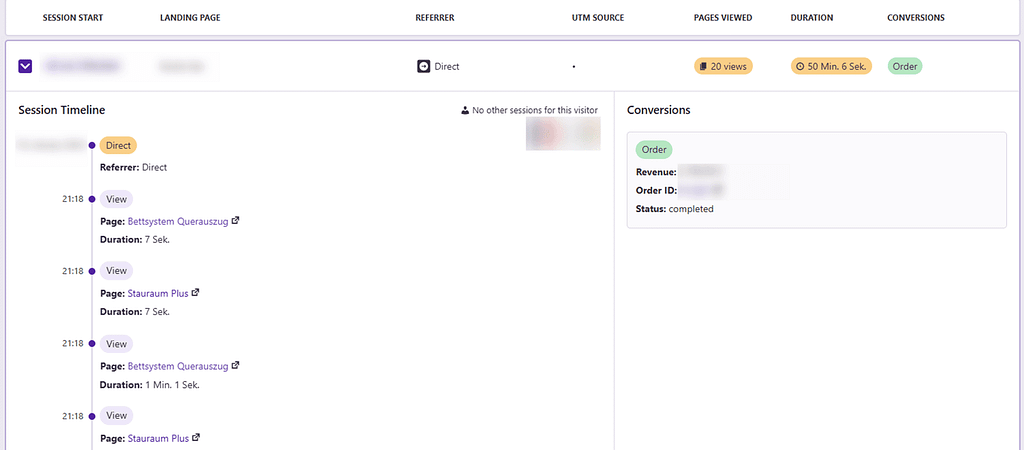
Our products are designed as modular systems, where certain items work best together to create a complete “room concept.” A prime example is the combination of our Rear Slide-out sleeping system and the matching Storage Space Plus. A major win for us was using the User Journeys feature to understand how customers navigate these dependencies.
The reports revealed a discrepancy: We saw high session durations (up to 50 minutes), but often combined with a very low time-on-page (around 10 seconds) within the active flow. Looking at the user journey in Independent Analytics, the cause became clear: “Tab-Hopping.”
Users were jumping back and forth between the sleeping system and the storage module. We interpreted this as a sign of uncertainty. Customers were likely trying to cross-reference dimensions or visualize the combination, but the layout forced them to switch pages constantly.
We saw a similar “ping-pong” pattern between product pages and our FAQ section, suggesting that critical information was hidden in the FAQs rather than being visible right where the purchase decision happens.
While analytics can’t read minds, these patterns gave us a strong hypothesis to act on. Based on these journey insights, we started optimizing the individual product pages to include clearer compatibility info and direct links to matching modules. By reducing the need for manual comparison, we keep users focused on building their setup.
In the future, we plan to use these insights to focus more on explaining the different room concepts by using more images or 3D models to visualize the possible combinations upfront.
3. Social media tracking and WooCommerce integration
For a brand built on visual inspiration, social media is our front door. However, “Likes” don’t pay the bills; sales do. One of the most powerful aspects of Independent Analytics is how it seamlessly bridges the gap between social engagement and our WooCommerce revenue.
In the past, we could see traffic coming from social platforms, but we had no easy way to compare the different channels based on data. Thanks to the eCommerce Analytics and the Referrers Report, we can now see the direct financial impact of each channel.
For instance, our data shows that YouTube drives the highest volume of long-duration sessions, while a platform like Facebook has a significantly higher bounce rate, indicating less interest or interaction and therefore less business value.
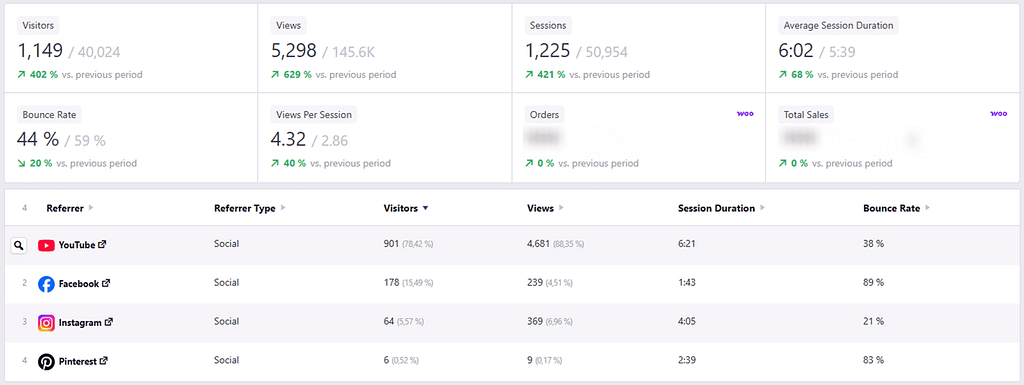
We no longer guess where to put our energy. Because the WooCommerce integration works out of the box, we can see exactly how our social channels are performing. If we see a spike in sales for a specific module, we can trace it back to the social source and double down on that content strategy.
Implementation and results: Zero setup, instant data
One of the main reasons we stuck with Independent Analytics was the “plug and play” nature. We needed a system that works, without the setup hassle every time you try out a new marketing strategy.
- Instant Setup, No Code: Unlike traditional tools that require complex header scripts or external cookies, this was a true “install and go” experience.
- 100% Data Ownership & GDPR Compliance: Since the data is stored on our own server and doesn’t pass personal data to third-party tech giants, we no longer worry about data privacy compliance regarding third-party trackers, cookie banners, or consent management.
- Faster Decision Making: We reduced the time spent specifically on analyzing traffic sources or fiddling with analytics tools. The saved time is now used for making instead of measuring.
- WooCommerce Integration: The native integration meant we didn’t have to configure “Goals” manually. Revenue tracking just worked out of the box.
Conclusion
Data we can rely on is the foundation for our decision-making. Tools like GA4 failed to provide a clear picture due to strict GDPR laws and cookie opt-outs.
For us, Independent Analytics isn’t just user tracking; it’s a strategic tool. It bridges the gap between technical data and business decisions. As our shop continues to grow, having a robust, privacy-first analytics tool directly inside our shop backend is non-negotiable.
If you are running a WooCommerce store and want to know who buys your products and why, without the headache of external enterprise tools, Independent Analytics is the way to go!
We’d like to thank Felix again for sharing this awesome case study! If you want to try Independent Analytics out on your site, you can click here to download it for free. If you have any questions for us, feel free to reach out via our contact form.
