


To see where your WordPress traffic is coming from, install an analytics plugin that reports referrer data inside the WordPress dashboard. The fastest option is Independent Analytics, a free WordPress analytics plugin that shows traffic sources without requiring Google Analytics or any code setup.
This guide covers how to view traffic sources in WordPress, how traffic sources are categorized, and how to act on this data to grow your website.
What’s the easiest WordPress plugin to see where my traffic comes from?
The easiest plugin is one that lives in your WordPress dashboard, requires no external account, and automatically categorizes traffic sources. Independent Analytics meets all three criteria, and it starts tracking the moment you activate it with no configuration required.
In the Analytics menu, you’ll find a Referrers report that lists every traffic source sending you visitors.
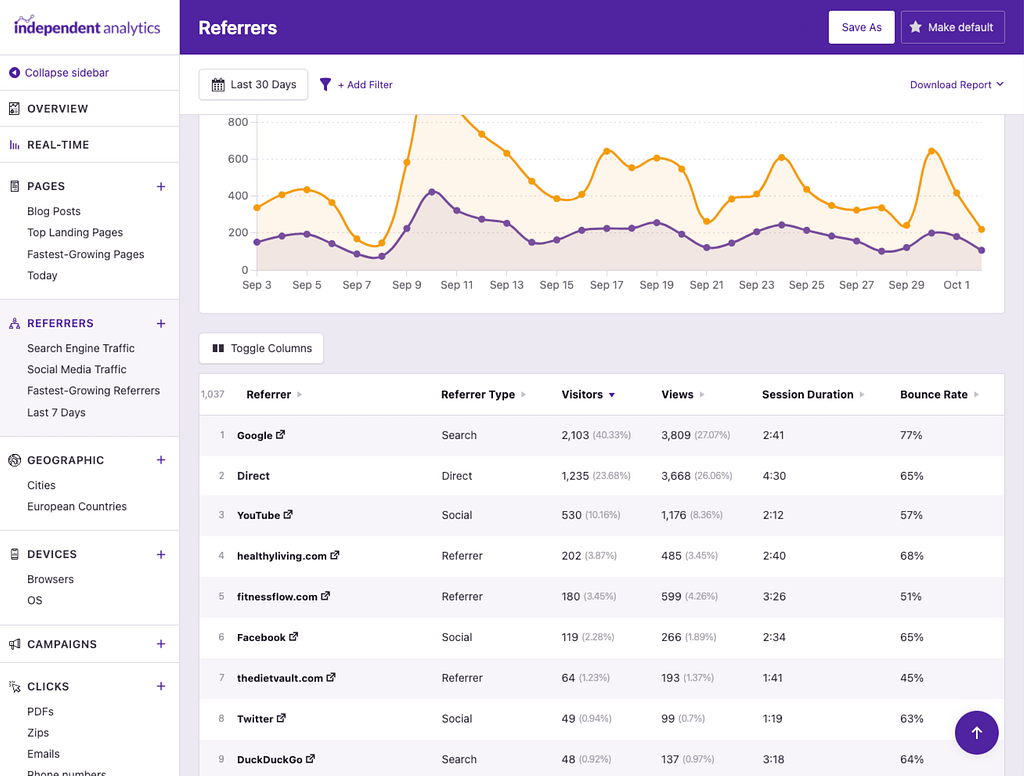
In seconds, you can find which sites are driving the most traffic to your website. You can also compare the engagement you get from each one by looking at metrics like bounce rate, average session duration, and views per session.
Even better, you can group the traffic sources by Referrer Type to get an overview of your marketing channels
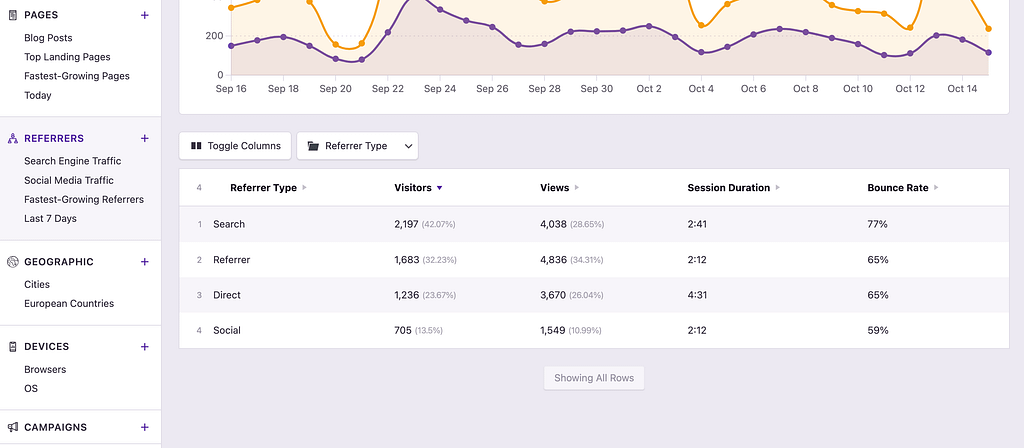
With this data, it’s easy to tell if you’re over-relying on search engine traffic or if you’re getting any AI citations yet.
Websites can generally be grouped into four different categories. Analytics tools determine the category by reading the referrer, which is the site your visitor came from.
- Direct traffic comes from visitors who arrived without a referrer. This usually means they typed your URL into the address bar, clicked a bookmark, opened a link from an app that strips referrer data (like many email clients and messaging apps), or followed a link from an HTTPS page to an HTTP one.
- Search traffic comes from search engines, like Google, Bing, DuckDuckGo, Yahoo, Yandex, and Baidu.
- Social traffic comes from social media platforms, including Facebook, X (formerly Twitter), LinkedIn, Pinterest, Reddit, YouTube, Instagram, and TikTok.
- Referral traffic comes from links on other websites that aren’t search engines or social platforms. A link from a blog, a directory, a forum, or a news site all count as referral traffic.
Some analytics tools, like Independent Analytics, will show two additional categories:
- AI traffic comes from AI tools like ChatGPT, Claude, Gemini, and Perplexity.
- Paid traffic comes from ad clicks. Independent Analytics recognizes paid traffic from Google Ads and Facebook Ads, for instance.
How do I see traffic sources broken down by page, not just site-wide?
Unfortunately, it’s no longer possible to see the exact page a visitor came from on another site. Browsers stopped sharing this data between August 2020 and March 2021 to better protect internet users’ privacy.
While you can see that you’ve had 100 visitors from Reddit, your analytics can’t show you exactly which pages on Reddit those visitors came from.
The way to win back some of this data is to use campaign links with UTM parameters. Campaign links let you see exactly how many people reached your site via that link, which is even more precise than seeing the referring page.
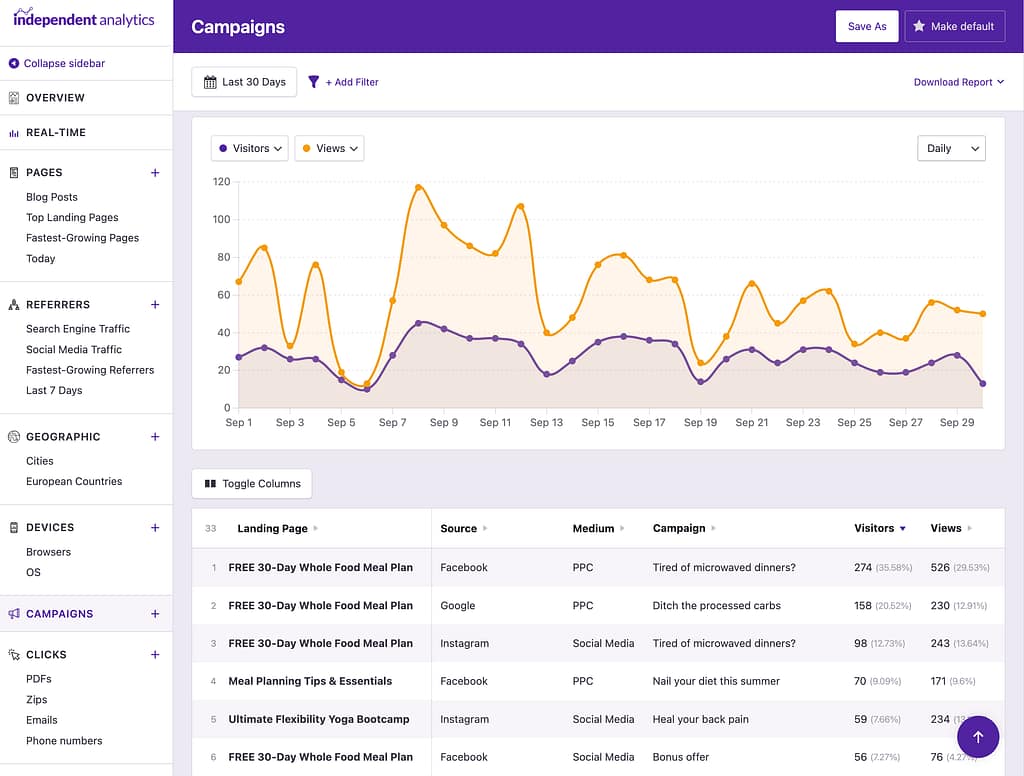
You can use campaign links whenever you link to your site. For instance, if you are sharing a link on Facebook and want to track the clicks, you can use a campaign link, and then you’ll be able to see precisely how many people reached your site via that link.
How do I filter out my own visits so they don’t skew the numbers?
Filtering yourself out of analytics is essential on low-traffic sites, where your own visits can easily double the visitor count, making the reports unreliable.
Analytics plugins have a variety of methods to ignore your own activity. Independent Analytics, for instance, offers four ways to exclude yourself:
- Exclude logged-in visitors. This is enabled by default and prevents any of your activity from being tracked while you are logged in.
- Exclude logged-in users by role. If you have some user roles you want to track, like Subscribers, but others you want to ignore, like Editors and Admins, you can ignore specific user roles.
- Exclude by IP address. You can add your home and office IP addresses to the exclusion list. This is useful for ignoring your activity even when you’re not logged in to the site.
- Exclude using a cookie. There is an option to enable a cookie that gets added to your own browser. This way, even if your IP address changes and you’re not logged in, your activity will still be ignored as long as the cookie hasn’t been removed.
Google Analytics offers similar IP-based filtering, but it must be configured at the property level and doesn’t include a one-click “exclude admins” option, which is one of the reasons WordPress-native plugins are easier to use.
What should I do with this information once I have it?
Traffic source data only matters if it changes a decision. Here’s how to act on it:
- Focus on your best traffic sources. If a specific site or marketing channel is working well for you, continue to invest in it to grow your traffic.
- Double down on the top organic pages. If a post brings in steady search traffic, expand it, update it, and build more internal links to it.
- Pitch yourself to your top referrers. If a blog or newsletter is sending real visitors, the author already likes your work. That’s a warm opening for a guest post, an interview, or a partnership.
- Tag every campaign. Add UTM parameters to every email, ad, and social link so you can see exactly which campaigns drive results.
See your WordPress traffic sources in five minutes
Seeing where your WordPress traffic comes from takes about five minutes: install Independent Analytics, activate it, and open the Analytics menu.
From there, you can break down traffic by channel, drill into individual pages, identify referring sites, and exclude your own visits to keep the numbers accurate.
